 Save
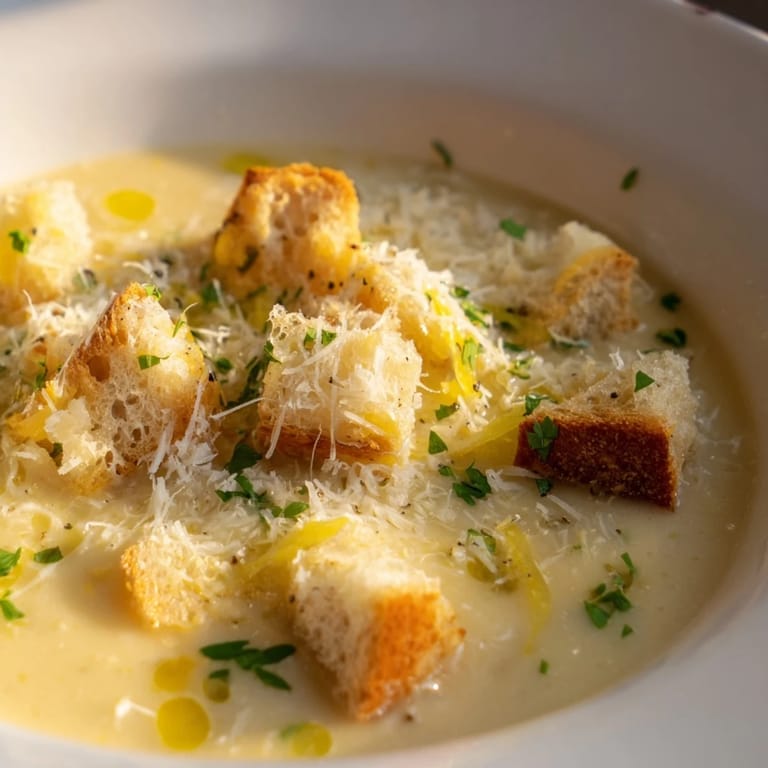
Save One rainy Tuesday, I found myself staring at a half-loaf of day-old sourdough and wondering if I could capture that garlicky, buttery warmth of garlic bread in liquid form. Something clicked—what if I toasted those cubes with aromatics and let them dissolve into a velvety broth? The result was this creamy garlic bread soup, a dish that tastes like comfort wrapped in a spoon. Now whenever the weather turns cold or I need something that feels both simple and luxurious, this is what I make.
I served this to my neighbor last winter when her kitchen was being renovated and she was living on takeout. She took one spoonful and immediately asked for the recipe—not because she wanted to make it herself, but because she wanted to understand how something so elegant came from a stale loaf and her pantry staples. That moment taught me that the best dishes aren't always the complicated ones; they're the ones that taste like someone genuinely cared.
Ingredients
- Day-old rustic bread (4 cups, about 200 g), cubed: Stale bread is non-negotiable here—fresh bread will turn to mush before it absorbs the garlic and thyme flavors, while day-old bread has just the right texture to dissolve into creaminess.
- Unsalted butter (2 tbsp): Butter and olive oil together create that rich, toasted flavor you get from real garlic bread, with the butter doing most of the taste work.
- Olive oil (2 tbsp): This raises the smoke point and helps you sauté without butter burning while you build the base.
- Yellow onion (1 medium), finely chopped: Onions mellow out as they cook and add natural sweetness that balances all that garlic.
- Garlic cloves (6 large), minced: This is the star—don't skimp or use pre-minced, because fresh garlic mellows into something almost creamy as it cooks in the broth.
- Celery (1 stalk), finely chopped: A small amount of celery adds subtle depth without announcing itself; it's the secret handshake in this soup.
- Fresh thyme (1 sprig) or dried (1/2 tsp): Thyme keeps the soup from tasting one-dimensional, adding an herbal whisper that makes you wonder what the flavor secret is.
- Fresh parsley (2 tbsp), chopped: Reserve this for garnish and a final brightness that cuts through the richness.
- Vegetable broth (4 cups/1 liter): Quality broth matters more than you'd think—a flat broth will make the soup taste flat, while a flavorful one carries everything.
- Heavy cream (1 cup/240 ml): This is added at the end to prevent it from breaking down during the long simmer, keeping it silky rather than separated.
- Parmesan cheese (1 cup/100 g), grated: Freshly grated Parmesan melts better and adds saltiness and umami that aged cheese brings—pre-grated has anticaking agents that make it grainy.
- Salt (1/2 tsp) and black pepper (1/4 tsp): Season in layers throughout cooking rather than all at once, tasting as you go.
Tired of Takeout? 🥡
Get 10 meals you can make faster than delivery arrives. Seriously.
One email. No spam. Unsubscribe anytime.
Instructions
- Start your flavor base:
- Heat the olive oil and butter in a large pot over medium heat until the butter froths slightly. Add your finely chopped onion, celery, and a pinch of salt, then sauté for about 5 minutes, stirring occasionally, until the onion turns translucent and soft—this is when you'll first catch that sweet onion smell that signals everything's working.
- Toast the garlic and thyme:
- Add your minced garlic and thyme to the pot and stir constantly for 2 minutes—you want the garlic to turn fragrant and golden, never brown. If you smell something toasty and warm rather than sharp, you're at the perfect moment to move forward.
- Introduce the bread:
- Scatter your bread cubes into the pot and stir until every piece gets coated with the garlicky oil and butter. Let them toast for 3–4 minutes, which allows the bread to absorb the flavors and start to release its starch into the oil—you'll notice the pot starts smelling like actual garlic bread at this point.
- Build the broth:
- Pour in your vegetable broth, bring it to a boil, then reduce the heat and cover the pot loosely. Simmer for 15 minutes, stirring occasionally, until the bread is so soft it falls apart when you touch it with a spoon. This gentle cooking lets the bread dissolve slowly rather than disintegrate.
- Blend into creaminess:
- Remove the thyme sprig, then use an immersion blender to puree the soup until it's completely smooth—or carefully transfer it to a stand blender in batches if that's what you have. The texture should be velvety but still pourable, not thick like a sauce.
- Finish with cream and cheese:
- Stir in the heavy cream and grated Parmesan cheese and let everything simmer gently for 3–4 minutes without boiling. Taste and adjust your salt and pepper—remember that Parmesan is already salty, so go easy at first.
- Serve and garnish:
- Ladle the soup into bowls and finish with a shower of fresh parsley and more Parmesan if you're feeling generous. A crack of pepper on top adds both flavor and a nice visual touch.
 Save
Save My daughter once described this soup as "the thing that tastes like someone hugged me with garlic," which might be the best food review I've ever received. That's when I realized this dish had crossed over from just being dinner into being comfort itself.
Why This Works as Both Starter and Main
The genius of this soup is that it tastes rich enough to be a main course but feels light enough to be a first course—no one will complain either way. Serve it in smaller bowls before a roasted fish or grilled chicken, and it becomes an elegant opener that makes people slow down and pay attention. Make it in larger bowls with some crusty bread on the side, and it becomes a complete meal that doesn't feel heavy, even though it's genuinely creamy.
The Art of Toasting Bread Right
That 3–4 minute toast step is where the magic happens, and it's worth not rushing. The bread develops a subtle nuttiness from the hot oil and butter, the garlic and thyme migrate into every crevice, and the whole pot starts smelling like a bakery that serves wine. If you skip this or rush it, you'll get a soup that tastes fine but forgettable—flat and one-dimensional. When you do it right, people will keep asking what makes it taste so deeply savory and complex.
Variations That Keep It Interesting
Once you've made this a few times and it becomes second nature, small tweaks transform it into something new while keeping the soul of the dish intact. The beauty is that it's forgiving enough to adapt to what's in your kitchen or what you're craving. Try these gentle shifts whenever the mood strikes or your pantry dictates.
- Rub your bread cubes with a cut raw garlic clove before toasting for an extra garlicky punch that hits you at the end.
- Add a small pinch of red pepper flakes to the pot when you add the garlic for a warmth that builds quietly on the back of your tongue.
- Top each bowl with homemade crispy croutons or a drizzle of garlic-infused oil for textural contrast and a reminder of that garlic bread inspiration.
 Save
Save This soup is the kind of dish that quietly becomes part of your rotation, the one you make when you want to feel taken care of or when you want to take care of someone else. It asks for very little and gives back something that tastes like it took all day.
Recipe FAQs
- → What type of bread works best?
Day-old rustic bread like sourdough or country loaf holds up well and absorbs flavors without becoming too mushy.
- → Can this soup be made vegan?
Yes, swap heavy cream with plant-based alternatives and use vegan Parmesan to keep it dairy-free.
- → How do I enhance garlic flavor?
Rubbing bread cubes with a garlic clove before cooking or adding garlic-infused oil as garnish enhances the garlic essence.
- → What herbs complement the soup?
Fresh thyme and parsley offer bright, savory notes that balance the richness of the broth and cream.
- → Is it necessary to puree the soup?
Pureeing creates a smooth, velvety texture that blends the bread and broth beautifully, but you can leave it chunky if preferred.